
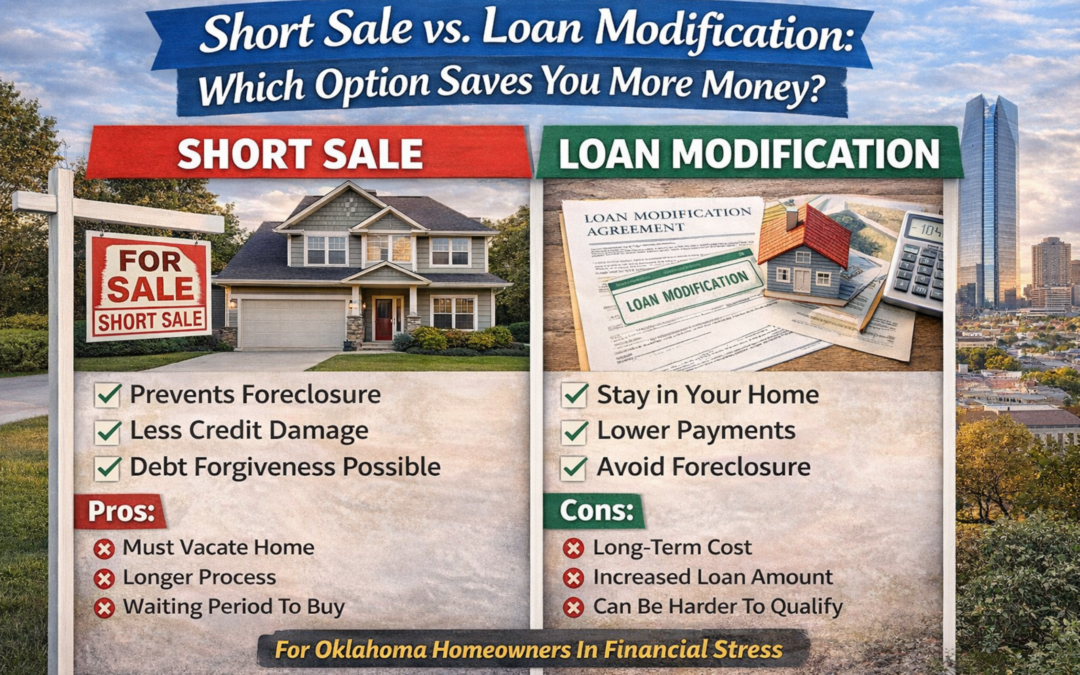
If you’re facing financial hardship, understanding short sale vs. loan modification: which option actually saves you more money is critical—especially for homeowners in Oklahoma City. While both options can help you avoid foreclosure, they work very differently. Therefore, choosing the right one can significantly impact your long-term finances, credit, and future homeownership opportunities.
In this guide, we’ll break down the key differences, costs, and outcomes so you can make the most informed decision.
What Is a Short Sale?
A short sale happens when you sell your home for less than what you owe on your mortgage, and the lender agrees to accept the reduced payoff.
Benefits of a Short Sale
- Avoids foreclosure
- Typically less credit damage than foreclosure
- Potential debt forgiveness
- Allows for a financial reset
Downsides of a Short Sale
- You must move out of the home
- Approval process can take time
- Temporary impact on your ability to buy again
However, a short sale often gives homeowners a cleaner financial slate compared to staying in a burdensome loan.
What Is a Loan Modification?
A loan modification is when your lender changes the terms of your current mortgage to make payments more affordable.
Benefits of Loan Modification
- Stay in your home
- Lower monthly payments
- Avoid foreclosure
Downsides of Loan Modification
- You may pay more over time
- Loan balance can increase
- Approval is not guaranteed
In contrast, while this option keeps you in your home, it doesn’t always reduce your total debt.
Which Option Saves You More Money?
The answer depends on your situation. Let’s break it down:
A Short Sale May Save You More Money If:
- You owe significantly more than your home is worth
- Your income cannot support the current or modified payment
- You need a fresh financial start
As a result, you eliminate ongoing mortgage debt and can rebuild sooner.
A Loan Modification May Save You More Money If:
- You can afford a reduced payment
- You want to keep your home long-term
- Your hardship is temporary
Therefore, you avoid moving costs and retain homeownership.
Key Financial Differences
| Factor | Short Sale | Loan Modification |
|---|---|---|
| Monthly Payment | Eliminated | Reduced |
| Total Debt | Potentially forgiven | Often increased |
| Credit Impact | Moderate | Moderate |
| Homeownership | Must sell | Keep home |
| Long-Term Cost | Lower (in many cases) | Higher over time |
Oklahoma Market Insight
In markets like Oklahoma City, where home values and affordability vary by neighborhood, your decision should also consider:
- Current home equity position
- Market demand for resale
- Future buying opportunities
Additionally, with steady buyer demand in OKC, a short sale may still attract offers if priced correctly.
Common Questions (AEO-Optimized)
Is a short sale better than a loan modification?
It depends. A short sale is often better for long-term financial relief, while a loan modification is better for staying in your home.
Does a loan modification hurt your credit?
Yes, but typically less than foreclosure. However, missed payments leading up to it may already impact your score.
Can I qualify for a mortgage after either option?
Yes. Most homeowners can qualify again after:
- 2–4 years (short sale)
- Potentially sooner with strong financial recovery
Final Thoughts: Choosing the Right Path
Ultimately, when comparing short sale vs. loan modification: which option actually saves you more money, the best choice comes down to your goals.
- If you need relief and a reset → Short Sale
- If you want to stay and can afford it → Loan Modification
However, making the wrong choice can cost you thousands over time. That’s why having a clear strategy matters.
Need Help Deciding?
If you’re unsure which option is right for you, I can help you evaluate your situation and create a plan that protects your finances and your future.
Confidential. No pressure. Just clarity.